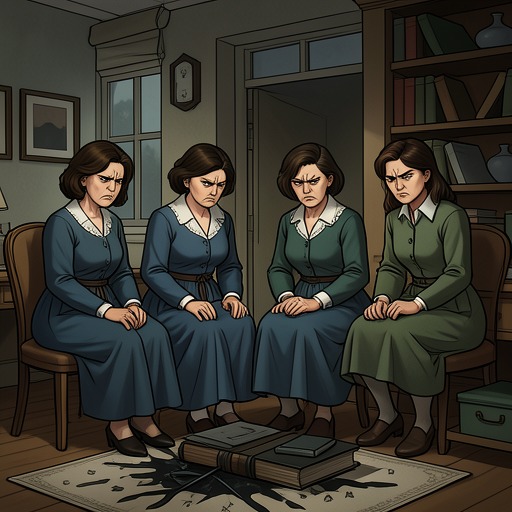
Do not let the sun go down on your anger
Little Women“Do not let the sun go down on your anger” is a rule of reconciliation that gives Little Women one of its clearest ethical rhythms: anger may arise, but it must not be allowed to harden overnight into pride, estrangement, or harm. Its force lies not in denying injury, but in requiring the injured person to choose repair before resentment becomes a settled way of relating to others.
Origin in Jo and Amy’s Conflict
Mrs. March states the rule when Jo refuses to forgive Amy after Amy burns Jo’s manuscript and Jo responds by excluding her sister from family life. The quarrel has disturbed the entire household. Beth cannot play as usual, Jo remains silent, Amy becomes defensive, and the family singing loses its former harmony. The conflict therefore becomes more than a private dispute: one person’s anger spreads through the home and alters its emotional order.
At bedtime, Mrs. March quietly tells Jo, “My dear, don't let the sun go down upon your anger. Forgive each other, help each other, and begin again tomorrow.” The language joins forgiveness to mutual aid and renewal. It does not ask Jo merely to stop feeling wronged; it asks her and Amy to resume the work of being sisters. Jo is not yet able to obey. She wants to cry against her mother’s shoulder but regards tears as weakness, insists that Amy does not deserve forgiveness, and allows pride to preserve the injury through the night.
The next day, however, Amy falls through the ice, and Jo is forced to confront the possible consequence of their unfinished quarrel. Believing that Amy might have died because of her hardness of heart, Jo admits, “I let the sun go down on my anger. I wouldn't forgive her, and today, if it hadn't been for Laurie, it might have been too late!” The rule now carries the weight of physical danger and irreversible loss. When Amy wakes and opens her arms, the sisters reconcile without an argument or explanation: they embrace and seal their forgiveness in a kiss. The principle is thus dramatized as an action rather than a maxim, with reconciliation restoring a relationship that anger had placed in peril.
From External Rule to Self-Control
The rule is inseparable from Mrs. March’s larger teaching about temper. Jo fears that her anger is unusually destructive, confessing that in a rage she feels capable of hurting someone and enjoying it. Mrs. March answers that she has struggled with anger for forty years and has learned to control its outward expression, though she still hopes to overcome the feeling itself. When anger threatens to produce words that will break out against her will, she leaves the room briefly and composes herself.
This account makes emotional restraint a continuing practice rather than a completed virtue. Mrs. March does not present herself as naturally calm or morally superior; she acknowledges an anger like Jo’s and describes self-command as lifelong work. Her example gives the rule psychological credibility. Jo is not told that a good person never becomes angry. She is shown that goodness consists in recognizing anger, interrupting its momentum, and continuing to try after failure.
The family’s moral vocabulary repeatedly treats work as a means of managing suffering and responsibility. When Mrs. March leaves for Washington, she tells the girls to continue their ordinary duties rather than comfort themselves through idleness: “Hope and keep busy,” she says, explaining that work is a blessed solace. In this context, not allowing anger to survive the night belongs to the same discipline as household labor and perseverance. Emotional repair, like domestic work, must be undertaken deliberately even when the heart resists it.
Jo and Laurie Practice the Rule
Jo later applies the lesson without Mrs. March’s immediate intervention. In a letter to her mother, she describes a quarrel with Laurie over a trivial matter. Jo believes that she was right, but she recognizes that she spoke improperly; Laurie is offended and declares that he will not return until she apologizes. Because both are proud, neither initially yields. Jo remains angry through the day, expects Laurie to come first, and feels justified in refusing to beg pardon.
At night, she remembers what Mrs. March said after Amy’s fall, reads her little book, and resolves not to let the sun set on her anger. She goes to Laurie’s gate to apologize and finds him coming to make the same gesture. Their mutual movement toward reconciliation changes the quarrel from a contest of pride into an acknowledgment of shared fault. They laugh, ask each other’s pardon, and recover their comfort. The scene shows that the rule has become portable: it no longer depends on a parent’s reminder but operates as Jo’s own moral judgment.
The episode also clarifies that the rule does not require one person to surrender the truth of a disagreement. Jo still believes she was right about the subject itself. What she corrects is her manner of speaking and her refusal to repair the injury. The distinction between being right and behaving rightly is central to the rule’s practical wisdom.
Marriage, Family, and the Labor of Repair
The same ethic governs adult relationships. When Meg and John Brooke experience their first serious disagreement, Meg recalls her mother’s warning about hasty words, pride, and the little misunderstandings that can lead to bitter sorrow. Her anger now looks childish to her, and the thought of John returning to an unreconciled home melts her resistance. She decides to be the first to ask forgiveness, crosses the room despite her pride, and kisses him on the forehead. The gesture settles the dispute before words are needed; John also acknowledges his fault and asks forgiveness for laughing at the jelly pots.
In Meg’s marriage, the rule becomes a form of preventative care. Mrs. March teaches her to watch herself, to apologize first when both have erred, and to guard against the small resentments that can accumulate into serious unhappiness. Marriage therefore depends not only on love but on repeated acts of humility. The first apology is not presented as defeat; it is a way of refusing to let pride determine the future of the household.
Mrs. March applies the same relational logic when Meg becomes absorbed in her children and unintentionally neglects John. She explains that Meg has made the common mistake of allowing maternal love to eclipse marital duty, warning that children should draw husband and wife closer rather than separate them. Her remedy is not accusation but deliberate restoration: Meg must make the home a place John wants to return to, because affection requires attention as well as feeling. The rule’s concern with anger thus extends into the broader labor of maintaining intimacy.
Grief, Forgiveness, and Moral Continuity
The principle also survives circumstances in which reconciliation cannot undo the loss. After Beth’s death, Jo is overwhelmed by unsubmissive sorrow and cries for her sister to return. Mrs. March comforts her at night through touch, tears, and patient presence, helping turn affliction into a chastening experience in which grief strengthens love rather than destroying it. Here the moral movement is not from anger to a restored conversation, as it is with Amy or Laurie, but from resistance toward endurance.
Beth’s faith provides the spiritual counterpart to this discipline. She cannot claim that death is welcome, because life is sweet to her; she can only say that she is trying to become willing. Her quiet trust does not rebuke Jo’s passionate protest. Instead, love remains the channel through which Jo is gradually drawn toward acceptance. The rule’s deepest implication is therefore not emotional suppression but the refusal to let pain become permanent hostility toward the living, toward love, or toward the duties that remain.
Ethical Significance
Across these episodes, “Do not let the sun go down on your anger” moves through several stages of moral development. Amy first encounters a lesson in consequence: breaking a rule brings punishment, and Mrs. March refuses to excuse her disobedience. Jo then learns that anger can become dangerous when pride delays forgiveness. Later, she and Laurie transform the principle into reciprocal self-correction, while Meg and John make it part of the ordinary maintenance of marriage. After Beth’s death, its energy appears in a more difficult form, as the family must continue loving and working while grief remains unresolved.
The rule’s power comes from its modest scale. It does not promise that anger will vanish, that every disagreement will be settled by perfect understanding, or that sorrow will quickly disappear. It demands only that resentment not be granted the night in which it might become harder, colder, and more destructive. In Little Women, that demand becomes a discipline of self-mastery and a safeguard for familial love: forgiveness is not a single grand moral triumph but the repeated decision to begin again tomorrow.